GoPay Savings, powered by Jago Bank — breaking the "transitory storage" mindset of e-money by
making it effortless to open a real bank account from inside Gojek.
Interactive prototype — from the Gojek home through zero-click KYC to an activated savings account
At a glance
Product GoPay Savings App
Powered by Jago Bank — making it effortless to open a real bank account from
inside Gojek, breaking e-money's "transitory storage" mindset.
Details
In-app onboarding · mobile
surface
Senior Product Designer — strategy, KYC flow, UI
role
GoPay · Jago Bank · Compliance · Growth
team
Acquisition · KYC · onboarding
scope
Problem Transitory storage
Users topped up only enough for their next few transactions. Native registration converted at
~21%, with a ~60% drop on the very first value-prop screen.
Solution Zero-click KYC
Reuse GoPay's existing verification so users don't repeat themselves — autocapture KTP + selfie
liveness, and cut bank questions from 12 to 3, led by a clear benefit comparison.
Result Simpler onboarding
Bank questions cut 12→3 via unified KYC, ~1.6M Jago accounts opened inside
Gojek, attacking both blockers in the acquisition funnel.
12→3
Onboarding Questions
Via zero-click unified KYC
~1.6M
Jago Accounts Opened
From inside the Gojek app
21%
Starting Conversion
The baseline the redesign set out to lift
01 / Discovery
Finding the problem
We found that users think of e-money as transitory storage — they only top up
for 2–3 transactions.
A good example of another transitory storage is cash. Users don't withdraw a billion IDR when
they go to an ATM, but only withdraw enough for the next few transactions or till they can reach
an ATM again. If they're in an area where ATMs are hard to find, they withdraw more cash.
Similarly, people only top up enough e-money to cover the use cases they know they'll spend on,
and not more.
The only way to break this cycle is to build a product that incentivises longer-term
deposits.
Framing the problem: e-money behaves like transitory cash storage.
02 / Problem
The problem statement
We rolled out the native Jago registration flow on the Gojek app in Nov 2021 to
100% of our users — ~1.6 million users have opened Jago bank accounts from the
Gojek app to date.
We had acquired 20% of GoPay users through marketing campaigns and product
improvements, but growth was stalling behind two major blockers. Working from quantitative data,
I prioritised by funnel drop-off and urgency:
Low conversion on the native registration flow — only ~21% completed; it was simply too complicated.
No differentiated value prop for GoPay ↔ Jago — a ~60% drop on the very first value-proposition screen.
Fluidity of money — users couldn't see why moving money into savings helped them.
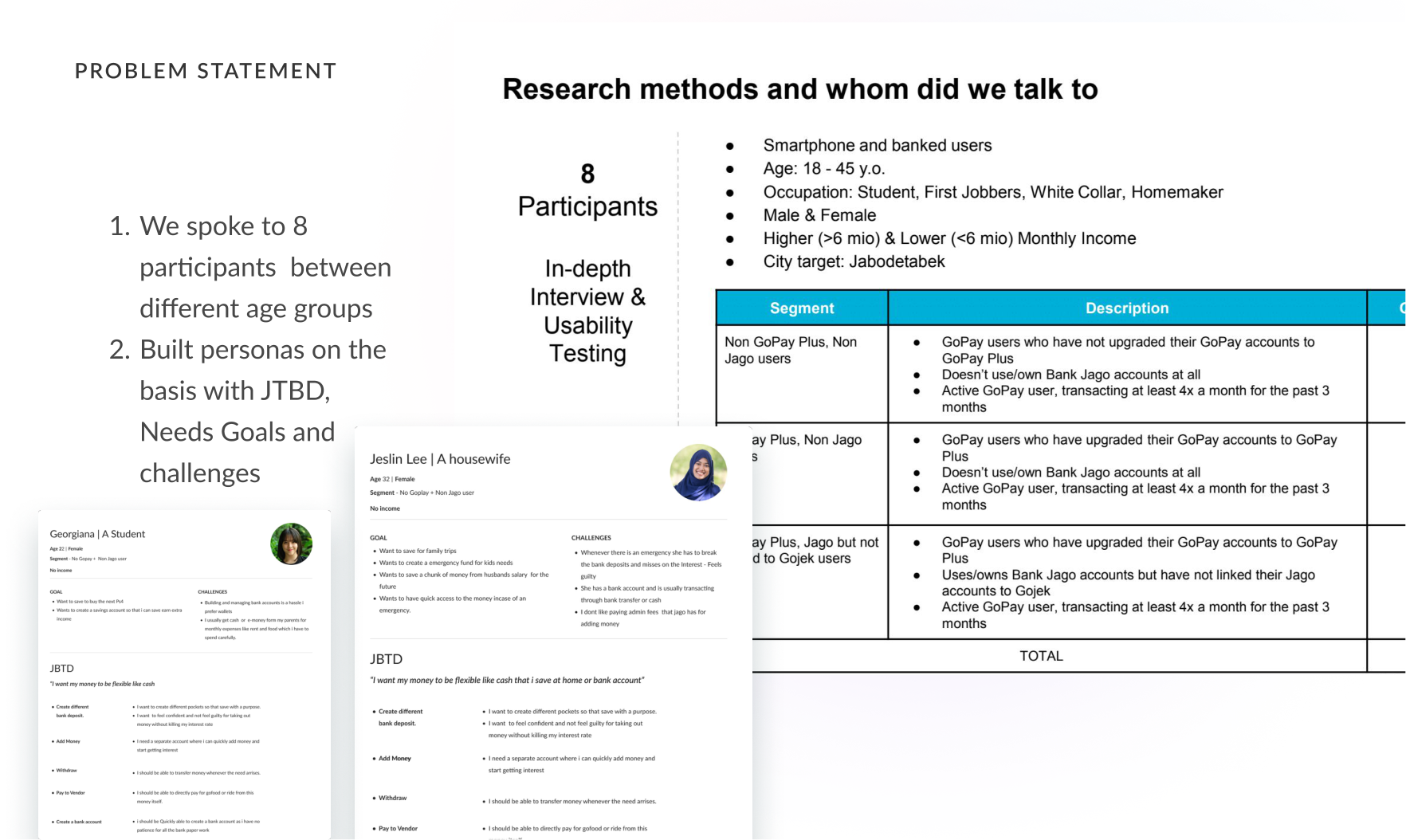
Background: native Jago rollout, ~1.6M accounts, and the two blockers stalling growth.Spoke to 8 participants across age groups; built JTBD-based personas.
03 / Research
Research
I combined the quantitative funnel picture with qualitative interviews — 8 participants across
different age groups — to understand the jobs, needs, goals and challenges behind the drop-offs,
and built personas to keep the team aligned.
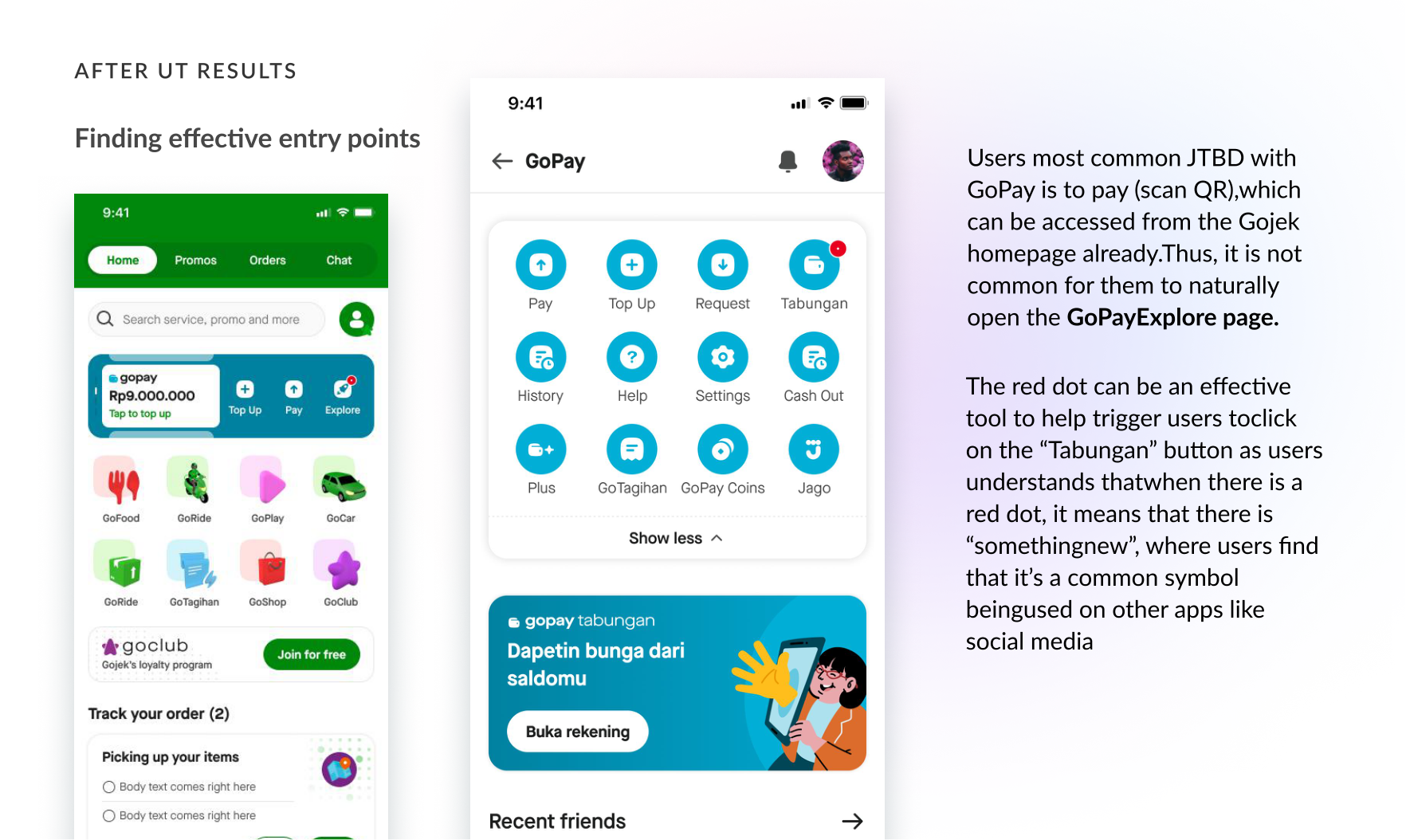
Users' most common job with GoPay is to pay (scan QR) — reachable from the home screen, so they rarely open the Explore page where savings lived.
Many assumed they'd need to create a separate Jago account to use GoPay Tabungan.
They saw no added benefit over the e-money they already used.
04 / Method
Method — simplify the KYC
The strategy: simplify onboarding via Jago's unified KYC, reusing verification
GoPay had already done so users didn't repeat themselves.
Zero-click KYC
Drop Jago's web-based liveness — rely on GoPay's compliant KTP / selfie liveness.
Autocapture of the KTP (ID) and selfie with passive liveness.
Cut bank questions from 12 to 3 — only source of income, monthly income and occupation.
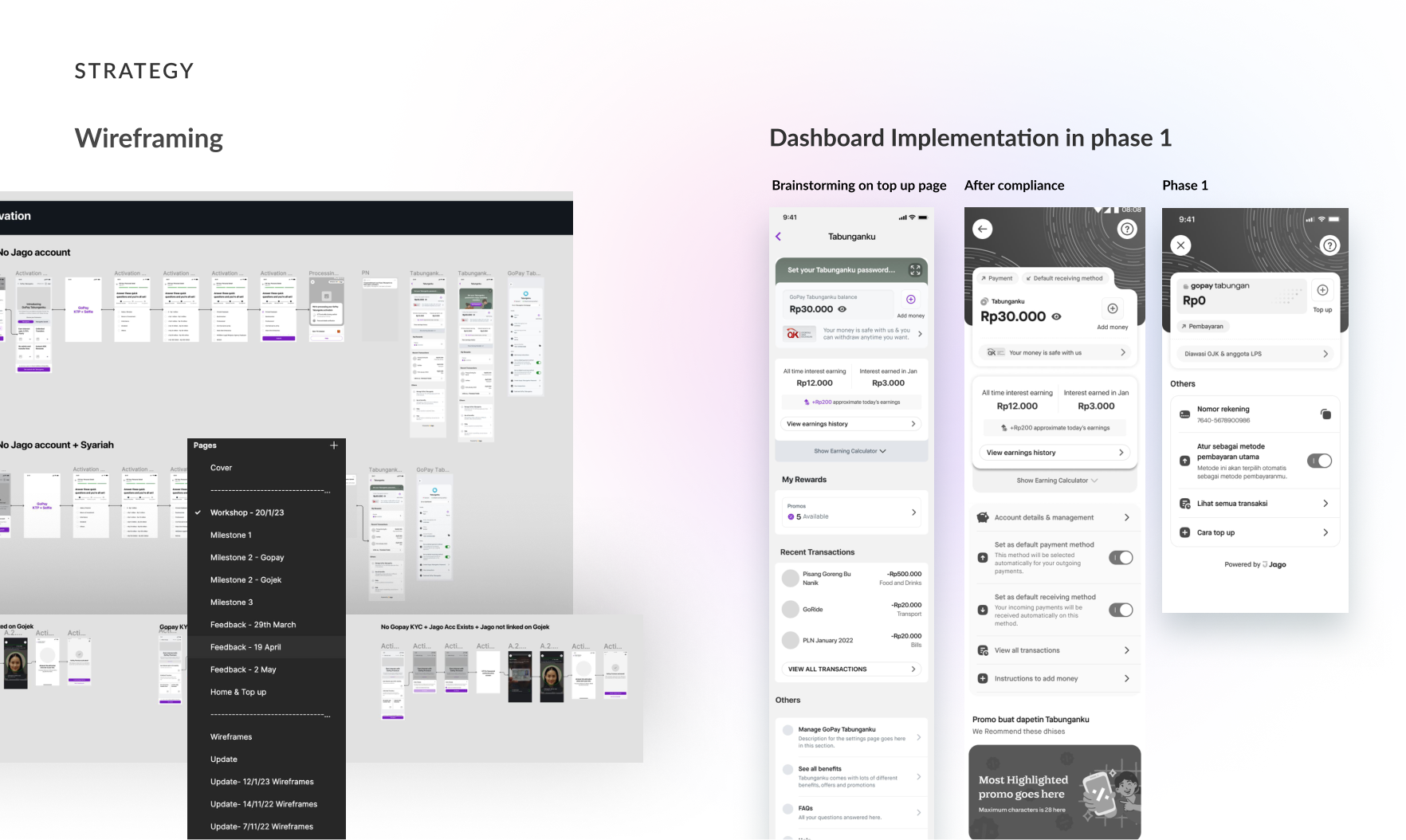
Wireframing the phase-1 dashboard and post-compliance top-up.
05 / Communication
Communication & MVP
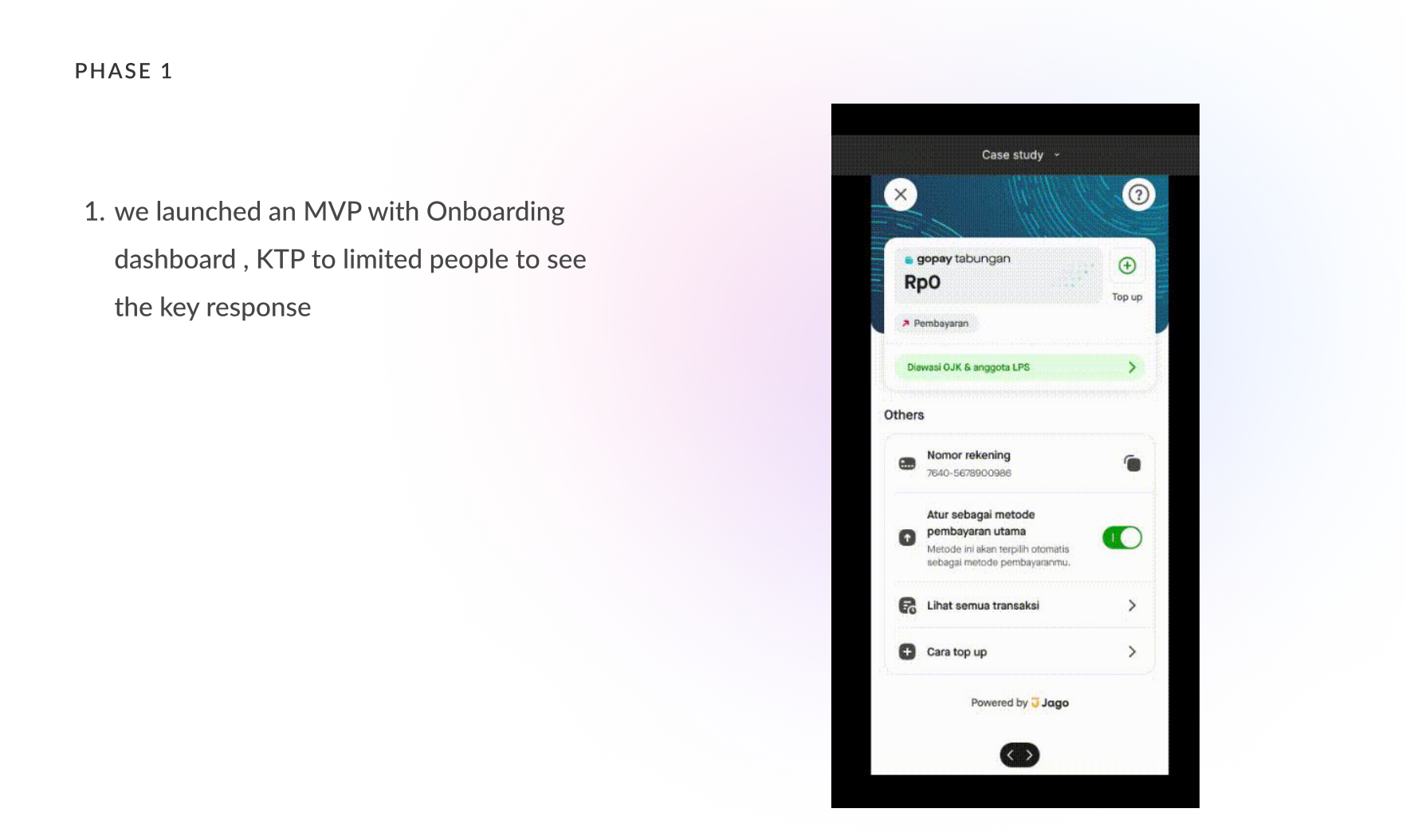
To de-risk compliance and learn fast, I shipped an MVP to a limited audience —
an onboarding dashboard plus the KTP capture flow — to read the key responses before a wider
roll-out, working closely with compliance and the Jago team throughout.
Phase-1 MVP: onboarding dashboard + KTP to a limited cohort.
06 / Iteration
Iteration after UT
Usability testing reshaped both the entry point and the onboarding.
Finding effective entry points
Since users naturally pay from the home screen and rarely open Explore, I used a familiar
red-dot cue on the Tabungan button — a universally understood "something new"
signal — to pull users in.
Using the red dot — a familiar pattern — to trigger discovery.
Revisiting onboarding
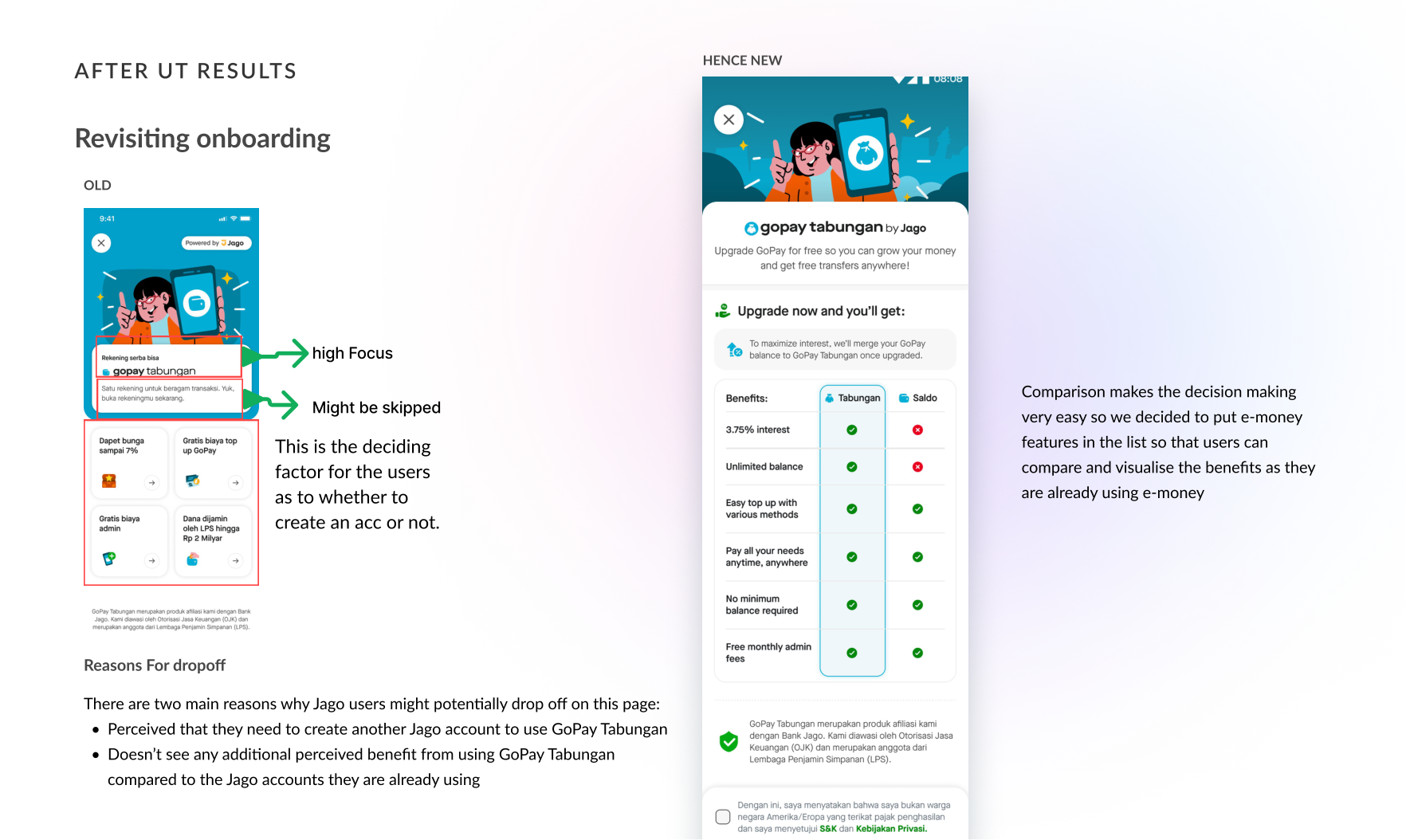
The old screen buried the deciding factor. I led with a clear comparison that
put e-money features beside savings, so users could instantly visualise the upgrade against what
they already knew.
Old vs new — a benefit comparison makes the decision easy.
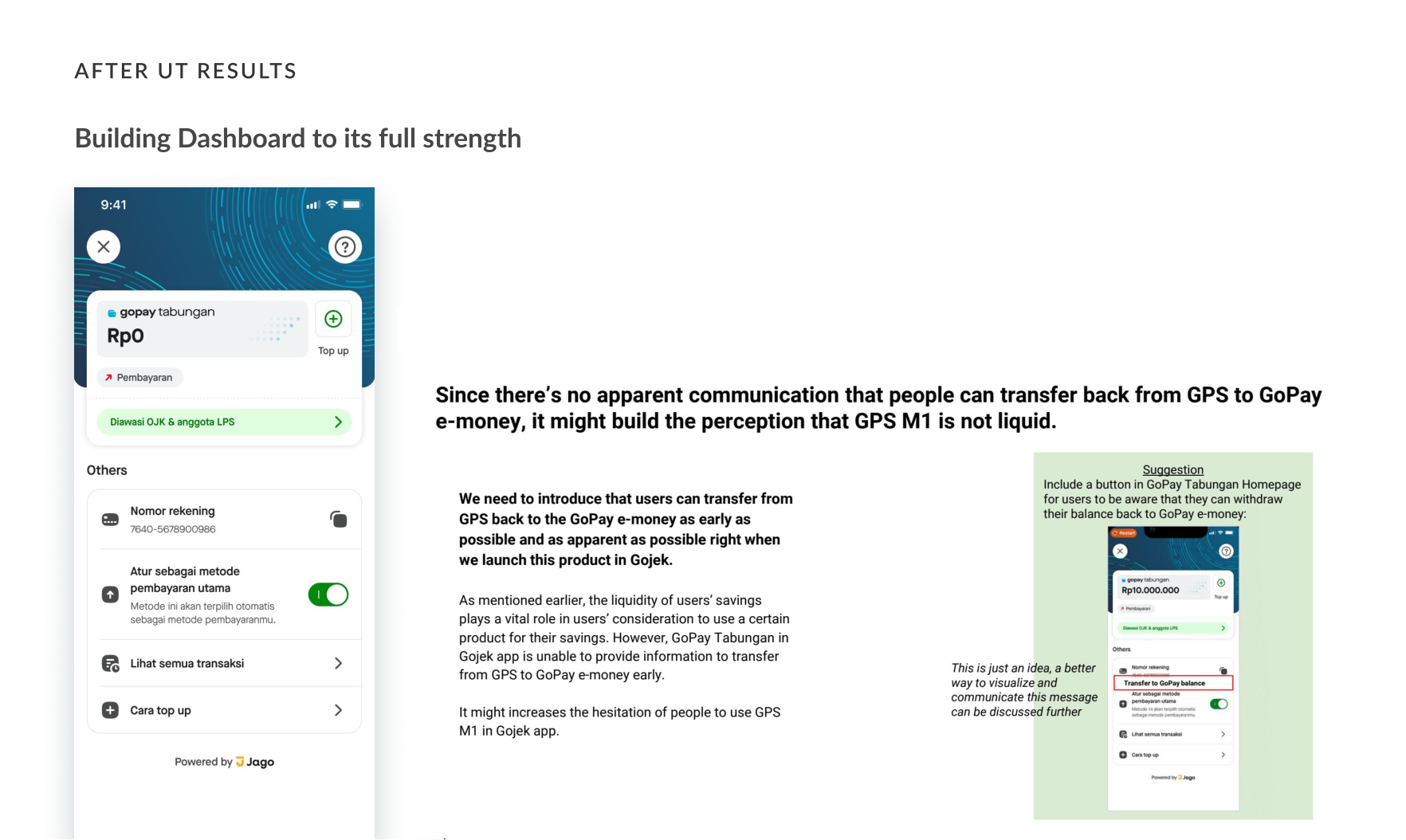
Building the dashboard to its full strength
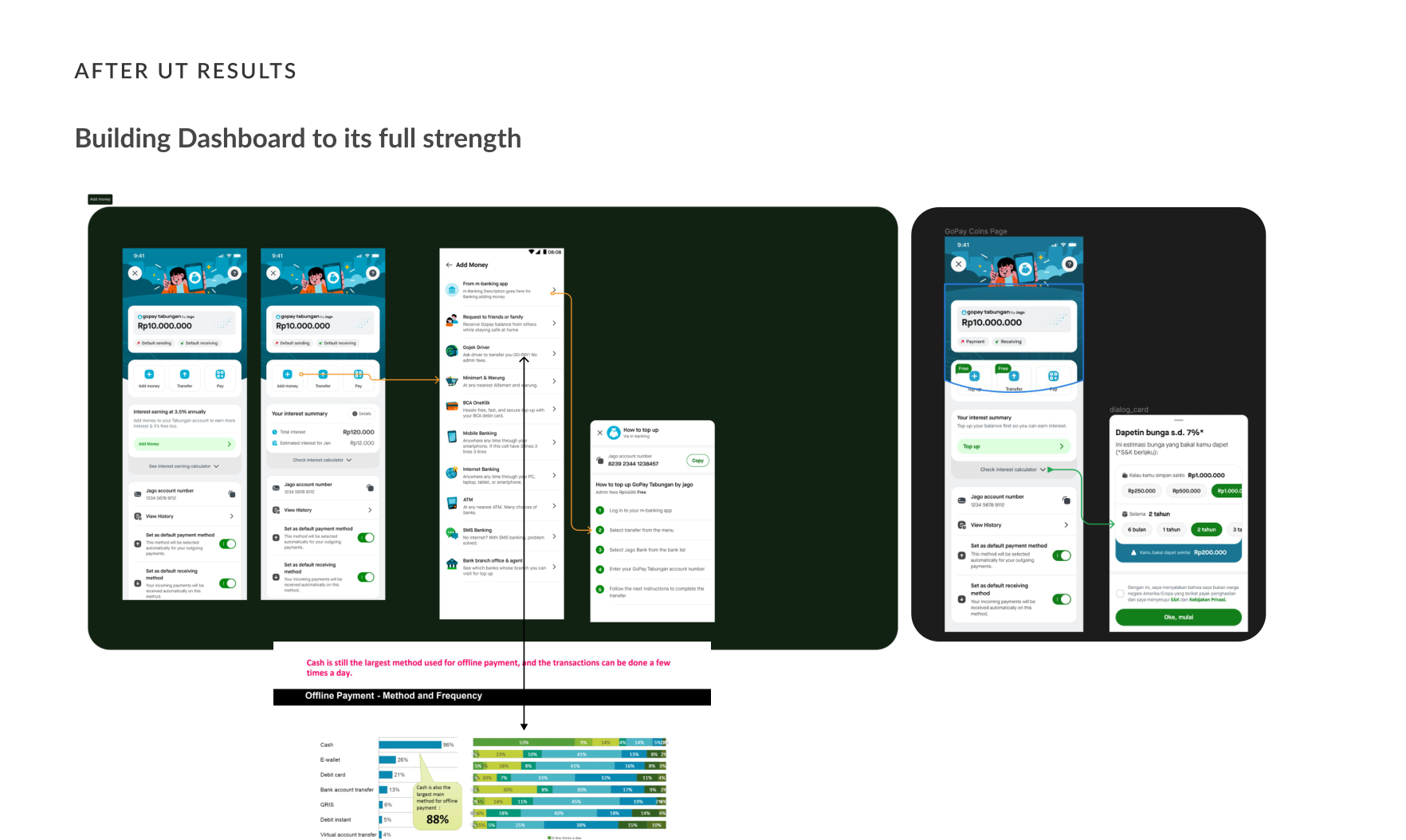
UT also surfaced a liquidity concern: nothing on the Tabungan homepage communicated that users
could transfer money back from savings to GoPay e-money. Without that signal, savings read as
"locked," which quietly raised hesitation to use it in the first place. The fix was to surface a
transfer-back path on the homepage as early and apparent as possible — right when the product
launches in Gojek.
Making the GoPay ↔ Tabungan transfer path visible, alongside a reworked offline-payment method and frequency flow.
Vision for next phase
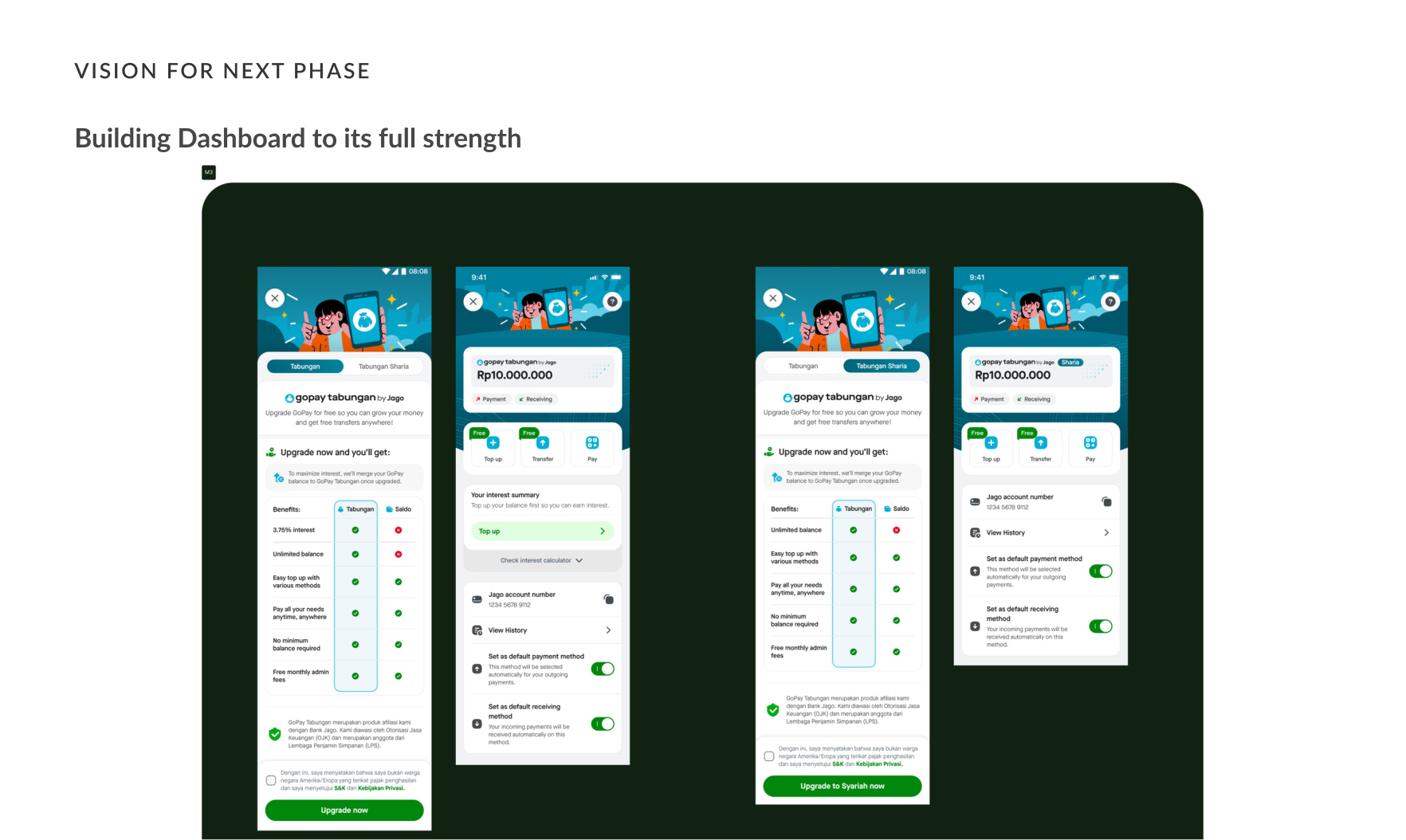
Looking ahead, I mapped an "Upgrade to GoPay Tabungan" flow that leads with a side-by-side
benefit comparison — so upgrading reads as an obvious improvement on the e-money account users
already trust, not a separate product to learn.
Next-phase vision: an upgrade flow that leads with the benefit comparison.
07 / Final
Final & prototype
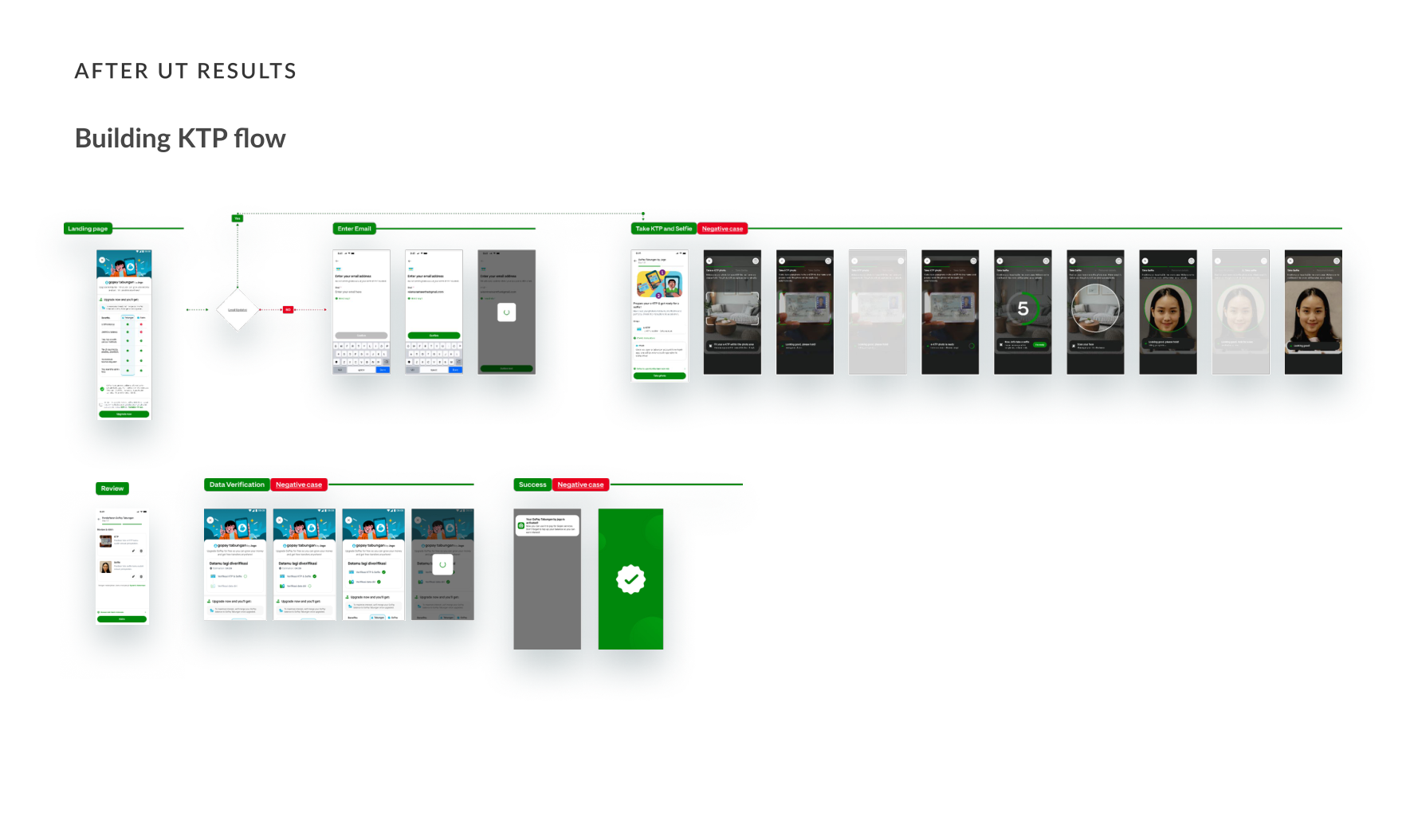
I built the KTP flow and the savings dashboard out to full strength — clarifying that money
moves freely between GoPay e-money and savings, so users never perceive savings as "locked".
The streamlined KTP capture flow.The savings dashboard — making liquidity between e-money and savings obvious.
08 / Impact
Impact
By simplifying KYC and reframing savings as an obvious upgrade — discoverable where users
already are — we attacked both blockers in the acquisition & retention funnel.
12 → 3 onboarding questions — via zero-click unified KYC.
~1.6M Jago accounts opened — from inside the Gojek app.
21% starting conversion — the baseline the redesign set out to lift.